In Spain at the eclipse site I got a couple of times the question, how the sun will look like visually and on their own camera. The majority was referring to their mobile phone when thinking about a camera. So in general, my reply was rather disappointig to them. You know why? It is easy to explain:
The size the sun as seen from earth, is half a degree in diameter. (Luckily, the moon is exactly the same size with minor variations, so we can witness solar eclipses 🙂 )
Mobile phone cameras have typical angles of view in the range of:
- 120 degrees in ultra wide angle camera (12 mm lens on full frame camera)
- 80 degrees on the main camera (wide angle) (24 mm lens on full frame camera)
- 10-20 degrees with tele camera (120-240 mm lens on full frame camera)
This means, that on the main sensor, the sun will only be a small circle with less than 1/100th of the image diagonal. If you are lucky and own a mobile phone with optical tele (zoom) with 10x or more and a 50 megapixel sensor, the sun will show up with some / reasonable size on your photo. Still, it will not compare to decent tele photo lenses or telescopes simply due to optical limits of the tiny lenses in the mobile phone cameras. The key reason is called diffraction (waves passing through an aperture will alter their direction by some extent), which limits optics from exceeding resolution depending on the aperture size of the lens. A large mobile phone camera lens with i.e. 10 mm diameter has a resolvin limit of approximately 12 arcseconds (1/300th degree). In comparison, a larger tele lens or smaller telescope with 72 mm lens diameter would be able to resolve 1.4 arcseconds.
To break it down, the following table has some technical information about the sizes of the sun on different cameras:
| Mobile phone camera | 36mm equiv. Focal Length | Diagonal FOV | Angular Resolution (50 MPx sensor) | Size of sun |
| 0.5x ultra-wide | 12 mm | 120° | 0.0118° / Px 42.33″ / Px | 42 Px |
| 1x main camera | 24 mm | 80° | 0.0078° / Px 28.22″ / Px | 64 Px |
| 10x tele | 240 mm | 10° | 0.0010° / Px 3.53″ / Px | 510 Px |
Probably easier to see are the real world examples… I took these images using the mandatory solar filters ahead of the 2024 eclipse. I wantet to see, how much of the corona would fit in and how precise the tracking has to be for the required shots.
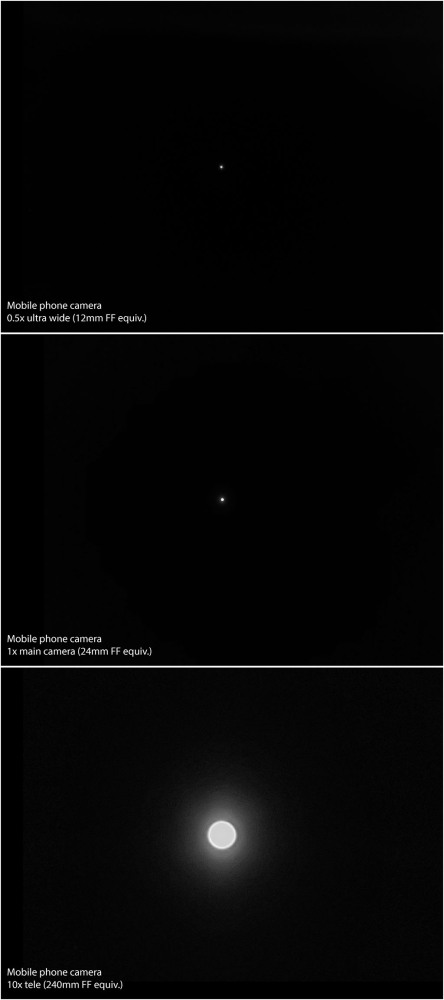
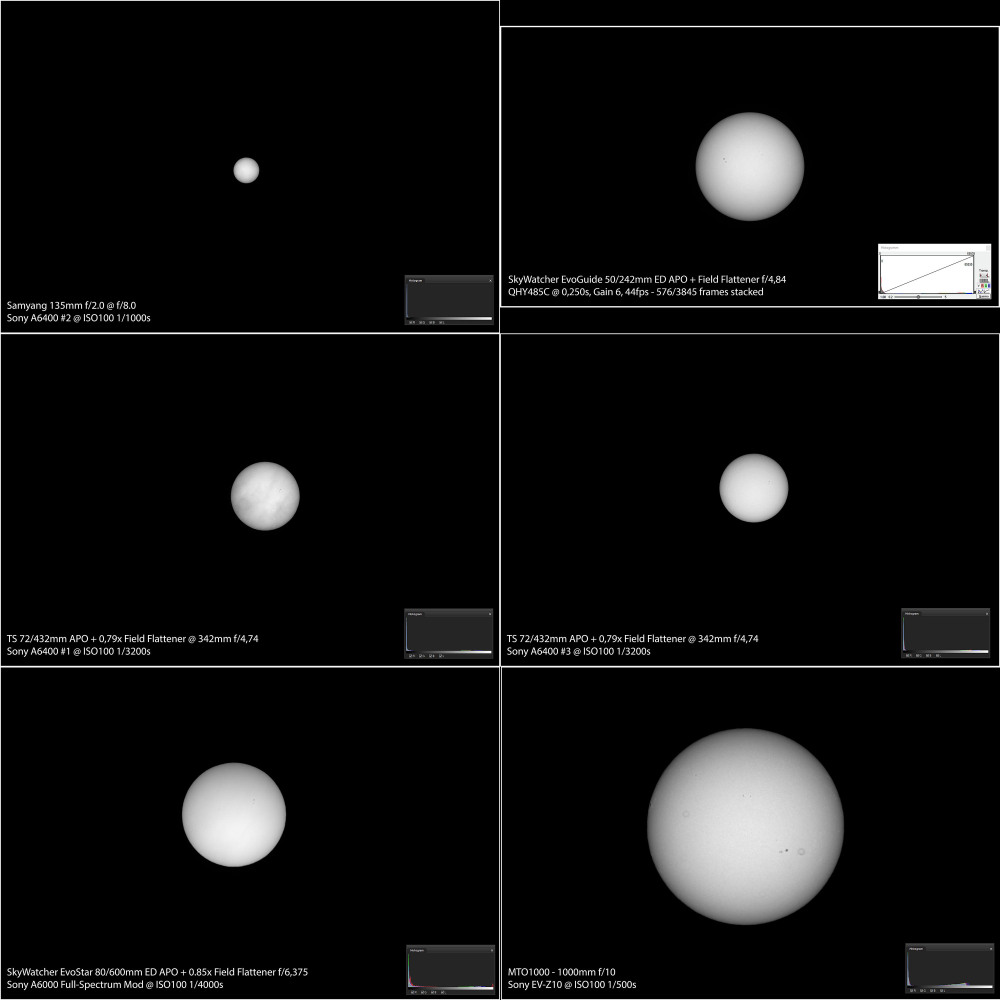
This demonstrates, that on the mobile phone, the sun is only a tiny dot. Even the tele camera is not showing details due to the optical limits. To photograph the sun with some details of the surface, a larger optic is required. But what a telescope or a large tele lens is not capable of to record is the whole scenery and the emotional impact of a solar eclipse. This would be the perfect use of the mobile phone.
Final word: No matter what you want to capture during a total solar eclipse – prepare everything to run as independent as possible. The few minutes of totality are best recorded in your own memory. Do not let the technical gizmos distract you from this uniqe moment!