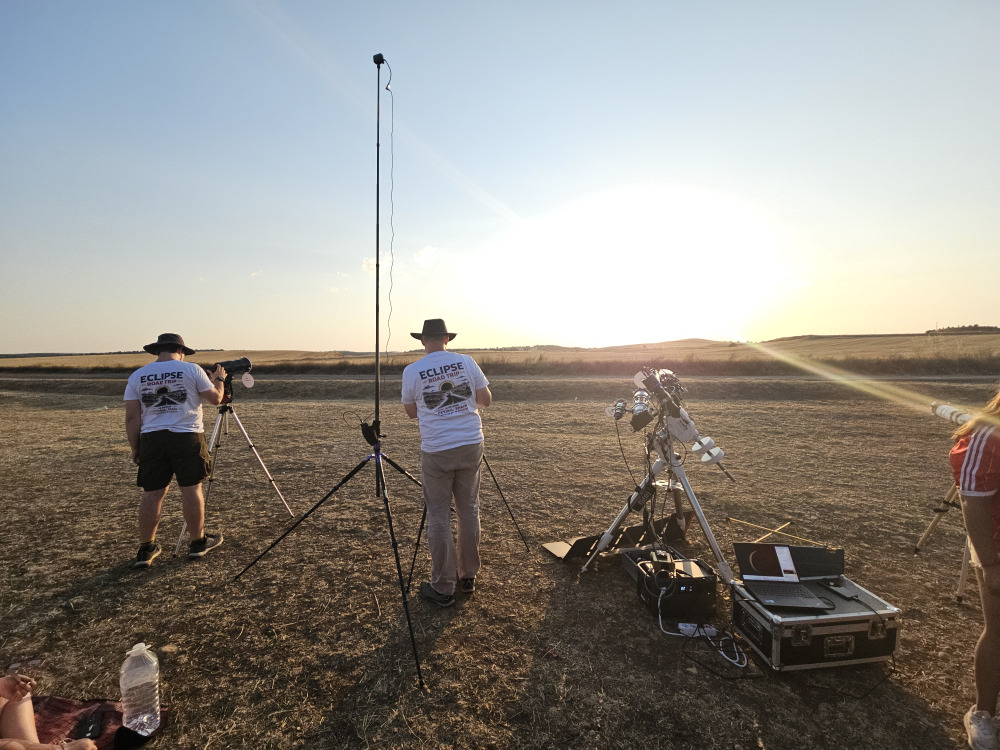
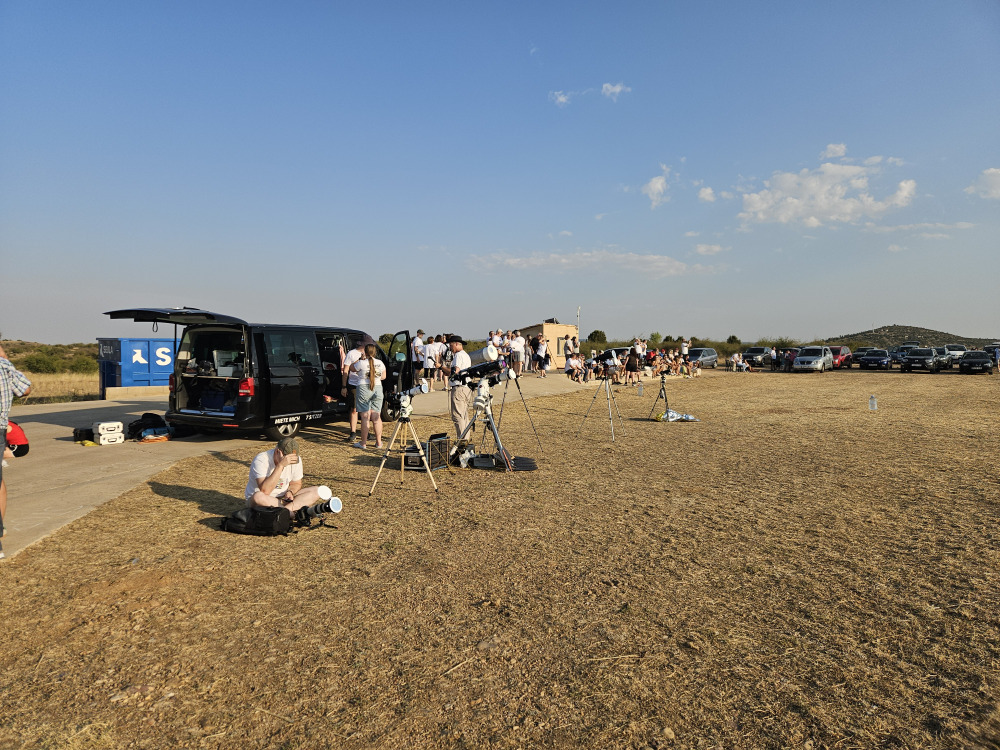
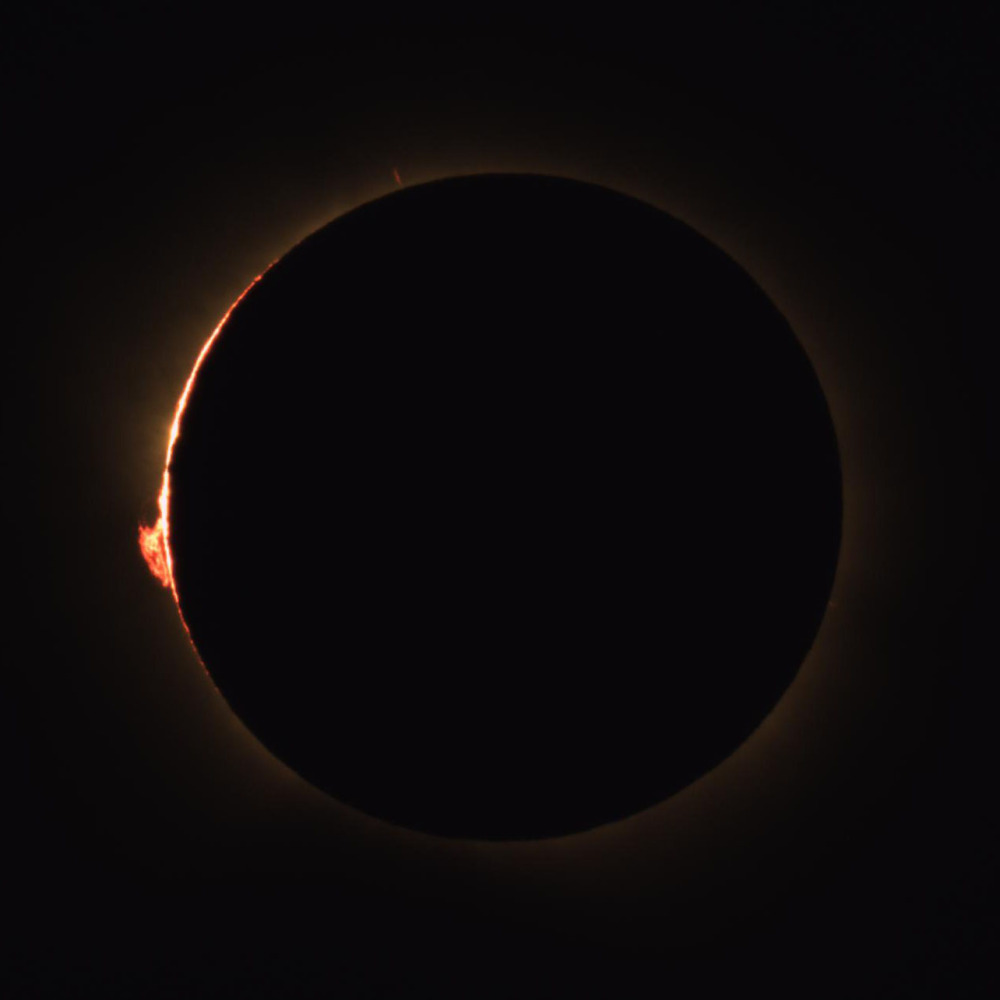
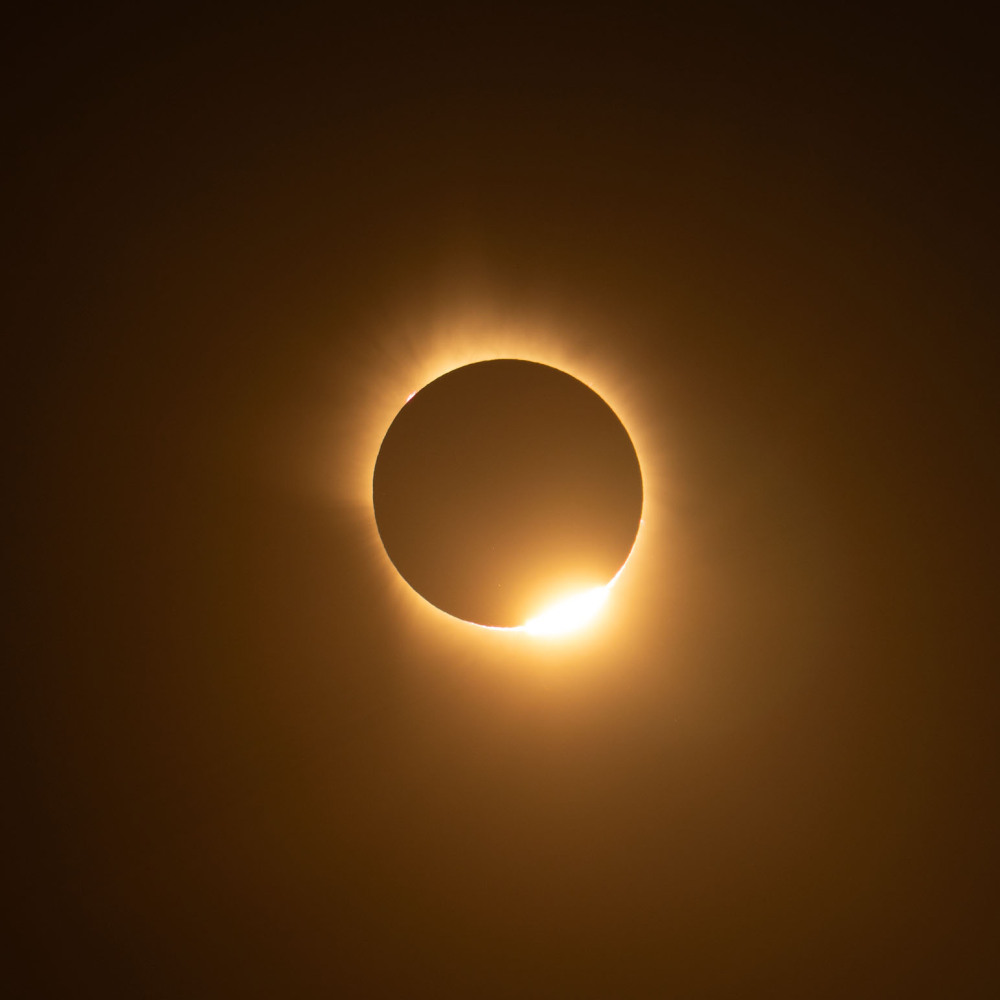
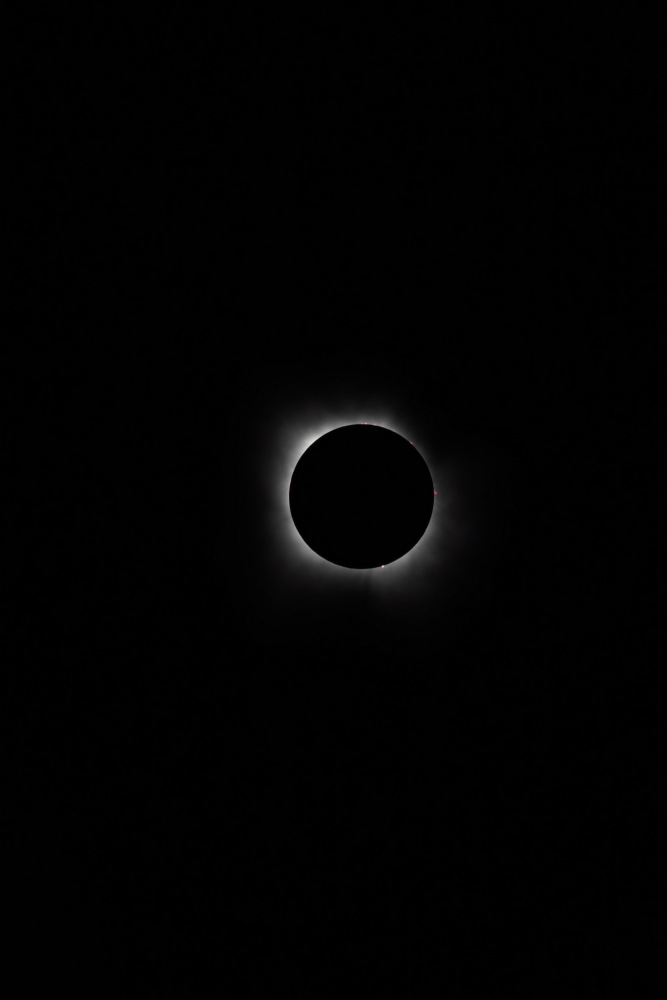
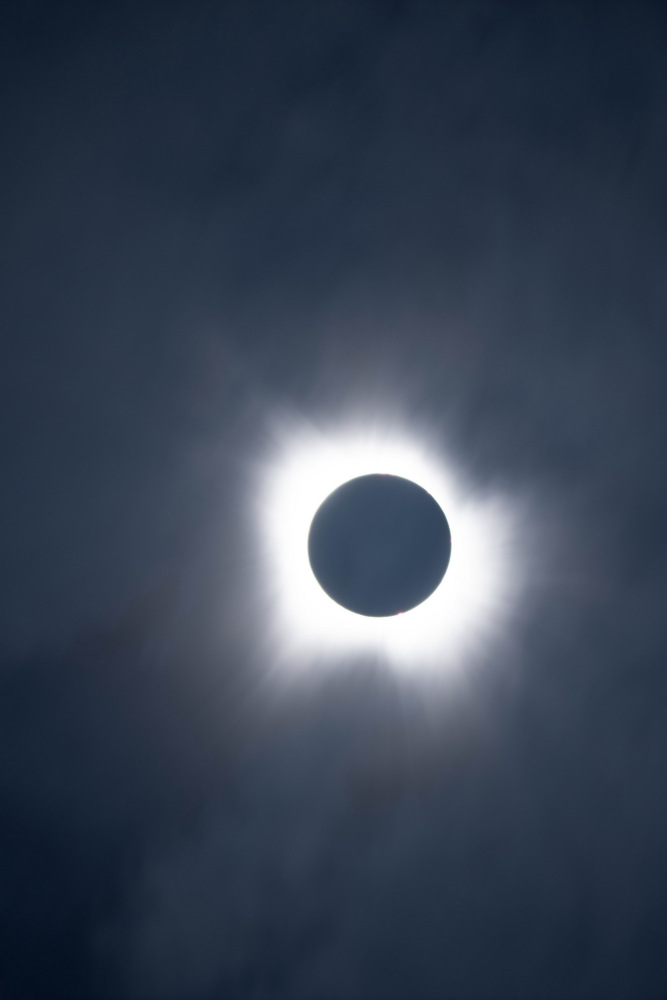
Preparations for this eclipse started already in 2019, when I first visited the villages of Cetina and Sisamon. The villages are just a few kilometers apart and are located between Madrid and Zaragoza. Especially the vicinity of Sisamon profed to have great spots for night time observations, as light pollution is pretty low. The same spot I observed in 2019 was also a perfect spot for the solar eclipse, as it lies approximately 1000m above sea level in a high plane. To the west, only some distant hills are seen, reaching 2 degrees above the horizon at maximum. This was crucial, as the totality would happen with the sun being only 7 degrees above the horizon.
Thanks to the mayor of Sisamon and my sister in law to communicate with him, I got the permission to setup my observation base at this very location. He also supported me in having my complete equipment without any obstacles and disturbances, despite a good 100 locals joining the event. They were all essential for the emotional experience, as many of them started cheering and shouting when totality arrived. A big THANK YOU to everyone involved to make this a perfect day!
According equipment, my primary goal was to get the shots for the Eclipse Mega Movie project (a Sonoma State / NASA project, I participated the third time). Then, some overview and especially landscape views of totality were on my plan, to also showcase the shadow of the moon.
In Spain at the eclipse site I got a couple of times the question, how the sun will look like visually and on their own camera. The majority was referring to their mobile phone when thinking about a camera. So in general, my reply was rather disappointig to them. You know why? It is easy to explain:
The size the sun as seen from earth, is half a degree in diameter. (Luckily, the moon is exactly the same size with minor variations, so we can witness solar eclipses 🙂 )
Mobile phone cameras have typical angles of view in the range of:
120 degrees in ultra wide angle camera (12 mm lens on full frame camera)
80 degrees on the main camera (wide angle) (24 mm lens on full frame camera)
10-20 degrees with tele camera (120-240 mm lens on full frame camera)
This means, that on the main sensor, the sun will only be a small circle with less than 1/100th of the image diagonal. If you are lucky and own a mobile phone with optical tele (zoom) with 10x or more and a 50 megapixel sensor, the sun will show up with some / reasonable size on your photo. Still, it will not compare to decent tele photo lenses or telescopes simply due to optical limits of the tiny lenses in the mobile phone cameras. The key reason is called diffraction (waves passing through an aperture will alter their direction by some extent), which limits optics from exceeding resolution depending on the aperture size of the lens. A large mobile phone camera lens with i.e. 10 mm diameter has a resolvin limit of approximately 12 arcseconds (1/300th degree). In comparison, a larger tele lens or smaller telescope with 72 mm lens diameter would be able to resolve 1.4 arcseconds.
To break it down, the following table has some technical information about the sizes of the sun on different cameras:
Mobile phone camera
36mm equiv. Focal Length
Diagonal FOV
Angular Resolution (50 MPx sensor)
Size of sun
0.5x ultra-wide
12 mm
120°
0.0118° / Px 42.33″ / Px
42 Px
1x main camera
24 mm
80°
0.0078° / Px 28.22″ / Px
64 Px
10x tele
240 mm
10°
0.0010° / Px 3.53″ / Px
510 Px
Size of the sun on mobile phone camera with 50 megapixel sensor
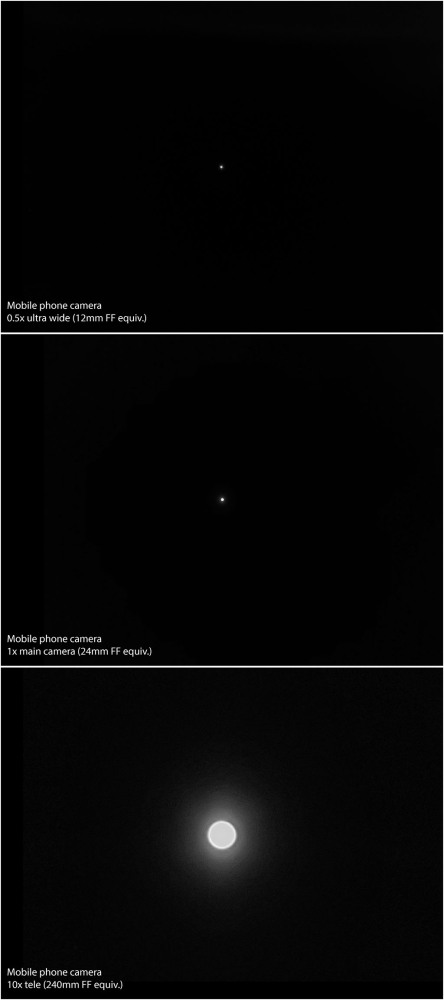
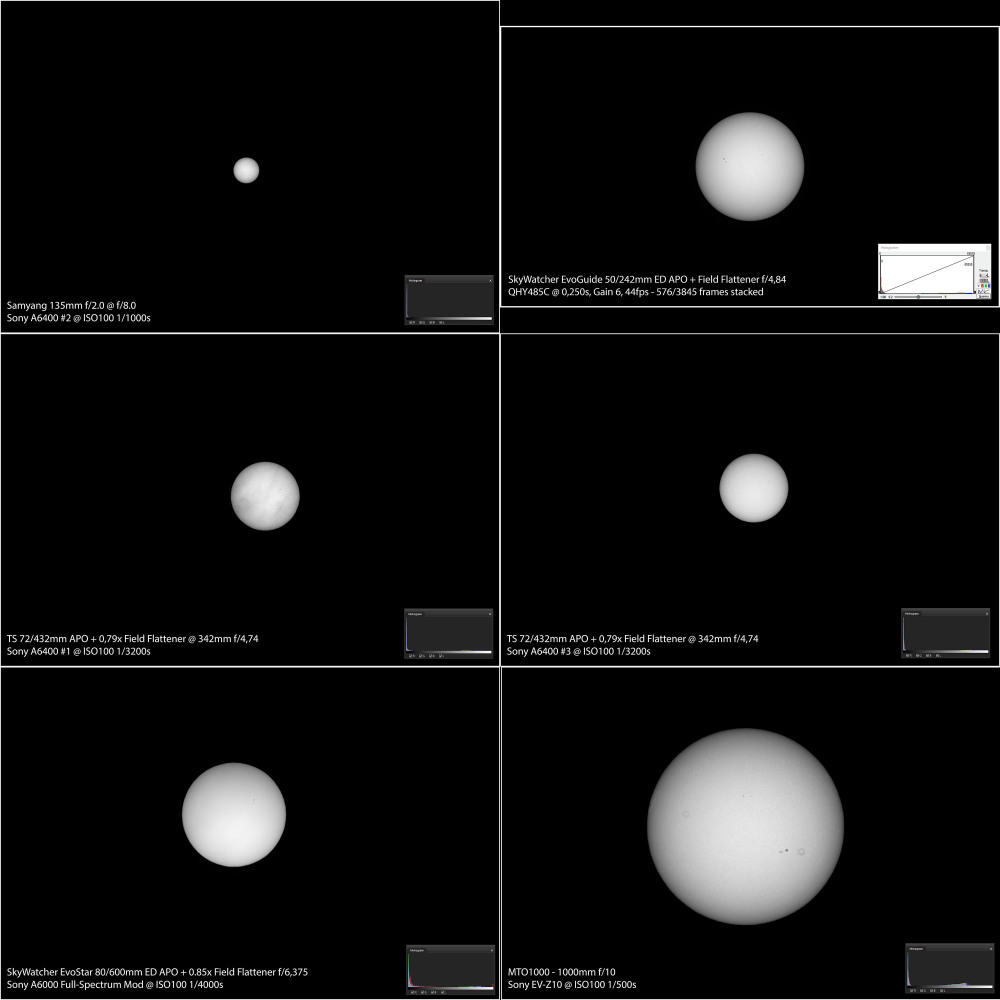
Probably easier to see are the real world examples… I took these images using the mandatory solar filters ahead of the 2024 eclipse. I wantet to see, how much of the corona would fit in and how precise the tracking has to be for the required shots.
This demonstrates, that on the mobile phone, the sun is only a tiny dot. Even the tele camera is not showing details due to the optical limits. To photograph the sun with some details of the surface, a larger optic is required. But what a telescope or a large tele lens is not capable of to record is the whole scenery and the emotional impact of a solar eclipse. This would be the perfect use of the mobile phone.
Final word: No matter what you want to capture during a total solar eclipse – prepare everything to run as independent as possible. The few minutes of totality are best recorded in your own memory. Do not let the technical gizmos distract you from this uniqe moment!
On August 12 I will be in central Spain to observe the solar eclipse. Apart from the regular camera setup, this time I will have a dedicated camera running, to show the sun being completely shadowed by the moon.
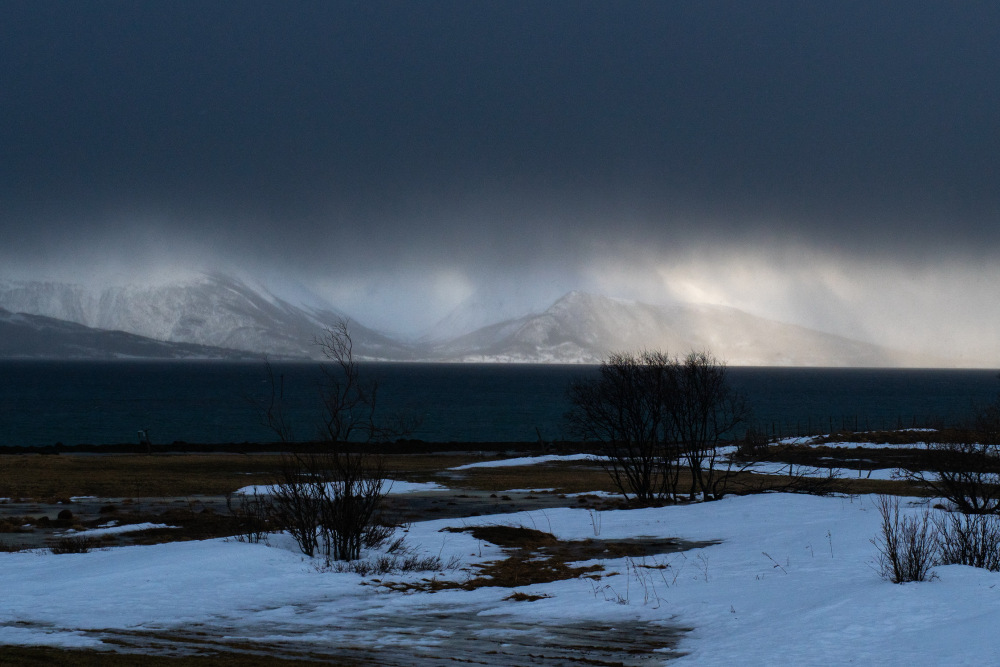
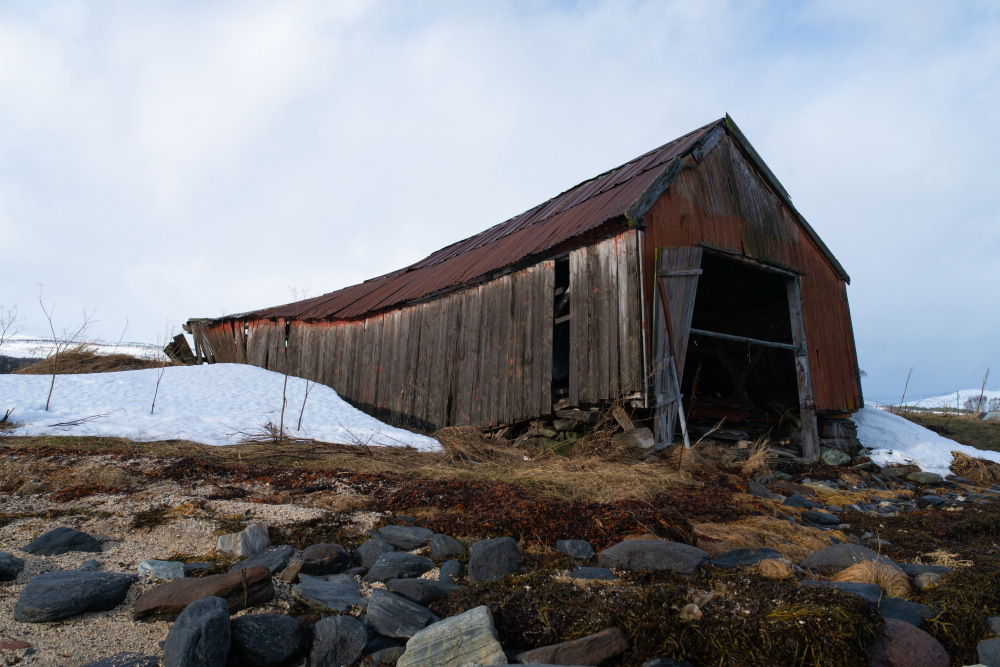
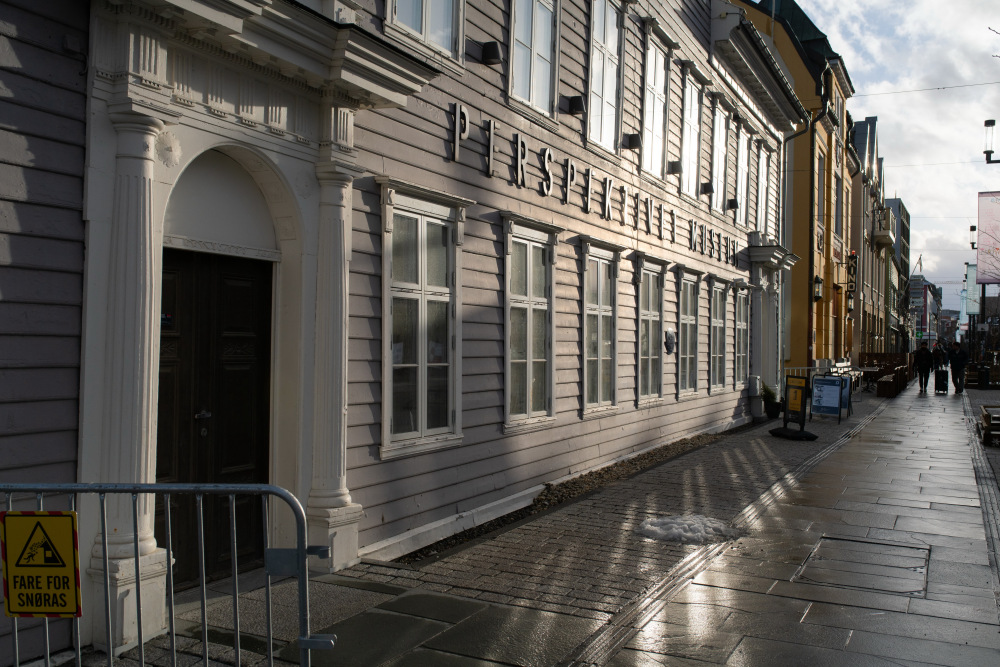
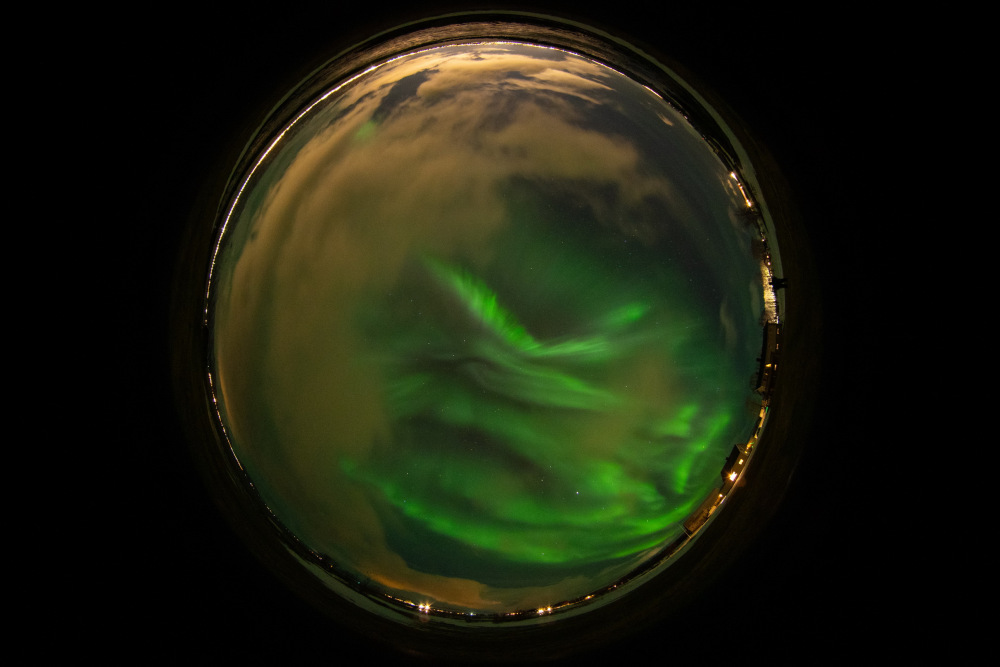
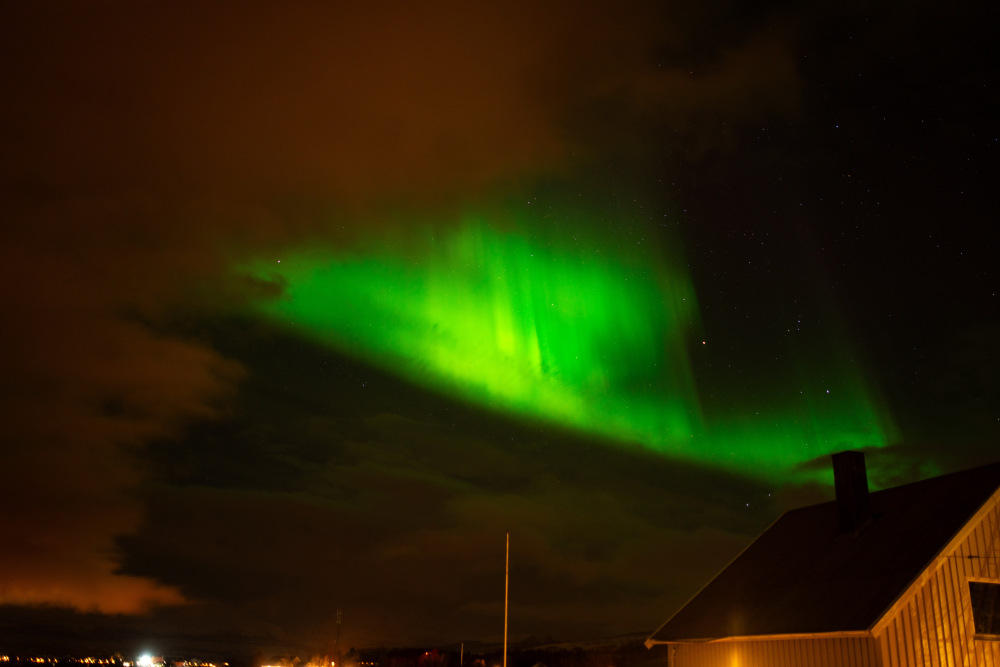
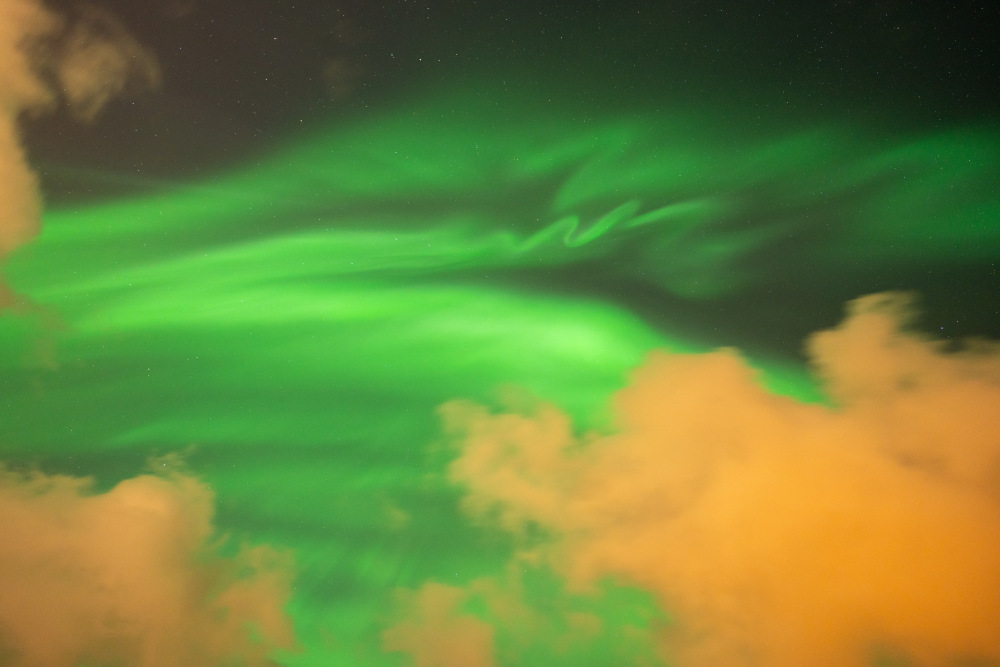
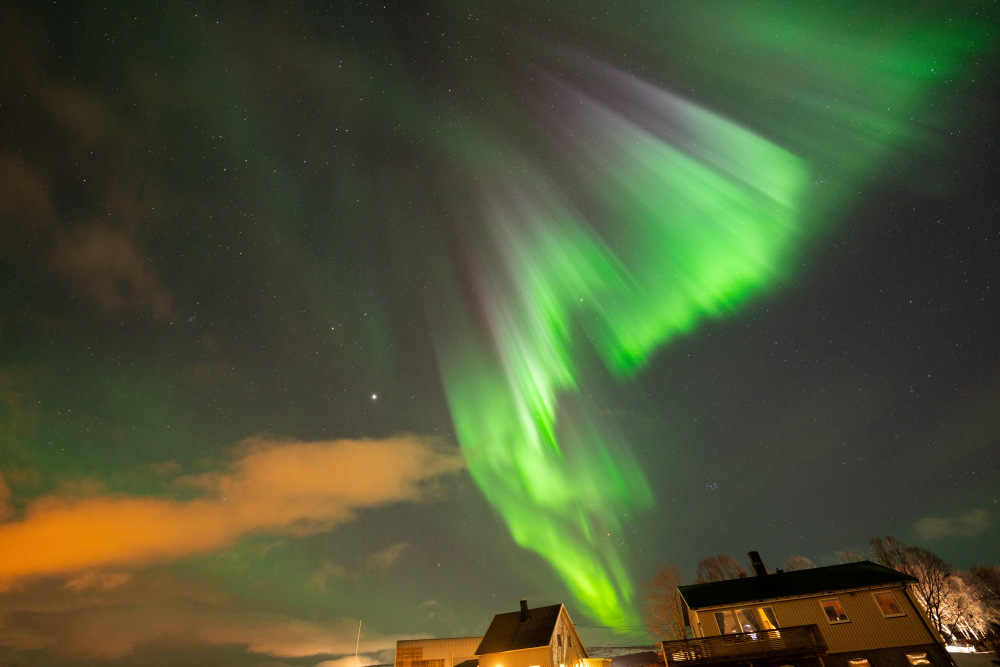
Hannes and Gerhard (two fellows from the astronomy club) invited me to join their endeavor to see the northern lights in Tromsø. It paid off to participate from the first moment on. Despite unpleasant weather forecasts, it was a great trip with beautiful sightseeing opportunities, good food, some drinks and relaxed time (waiting for the lights to come)
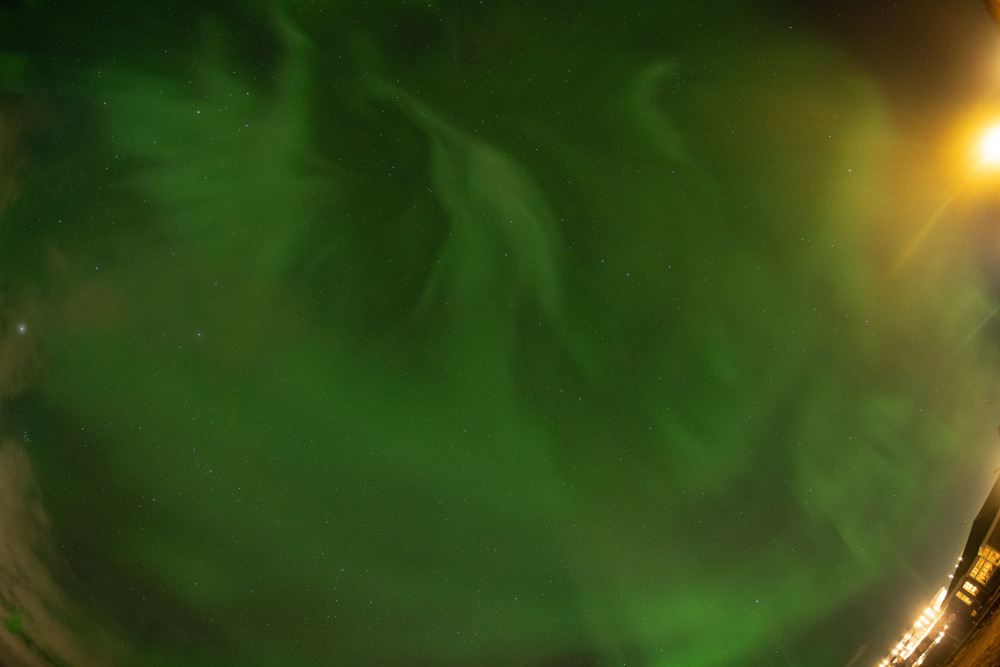
Only a few of the days in northern Norway were disturbed with unfavorable weather. We had like every type of possible weather conditions from strong wind, snowfall, icy roads to blue skies and temperatures above freezing. More off, from the 10 days we spent around Tromsø, we were fortunate to see the northern lights on 8 nights. Even more, on 3 of these nights, an auroral substorm provided beautiful and intense displays of colors (mostly green, but also red and violet), where sometimes all the surroundings were cast in green light.
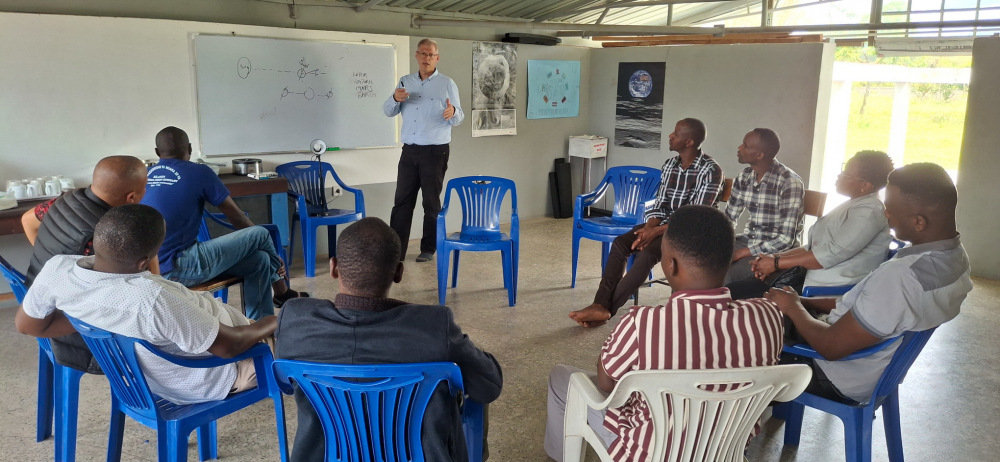
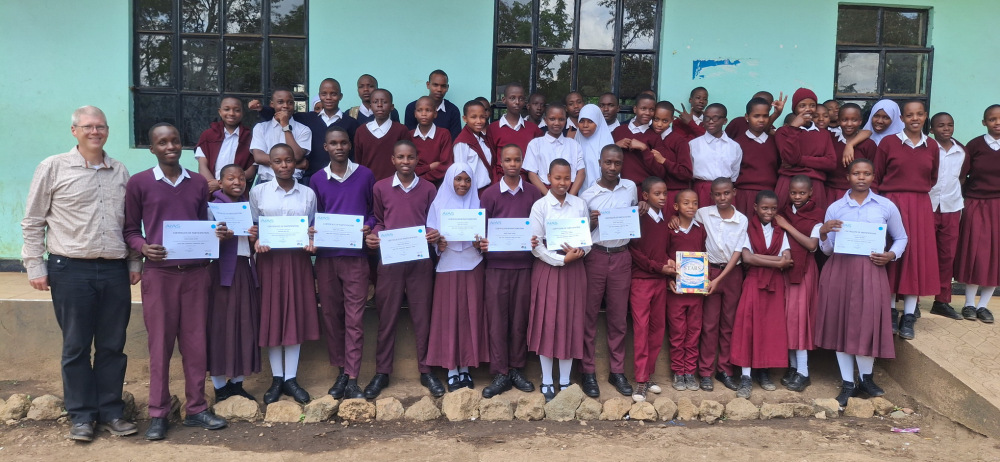
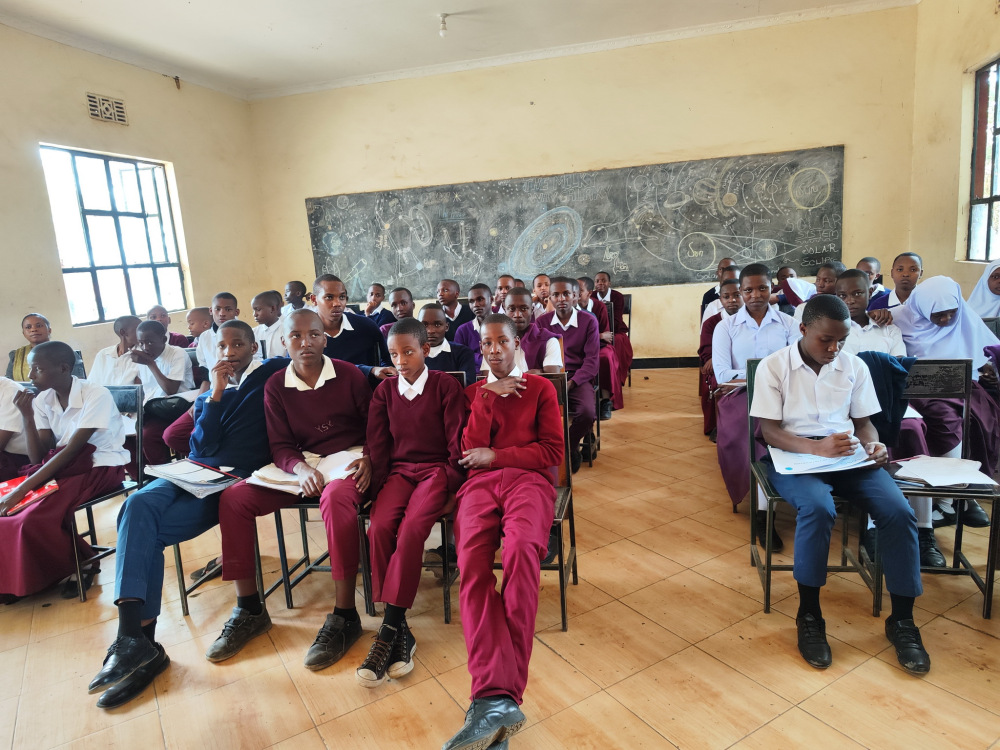
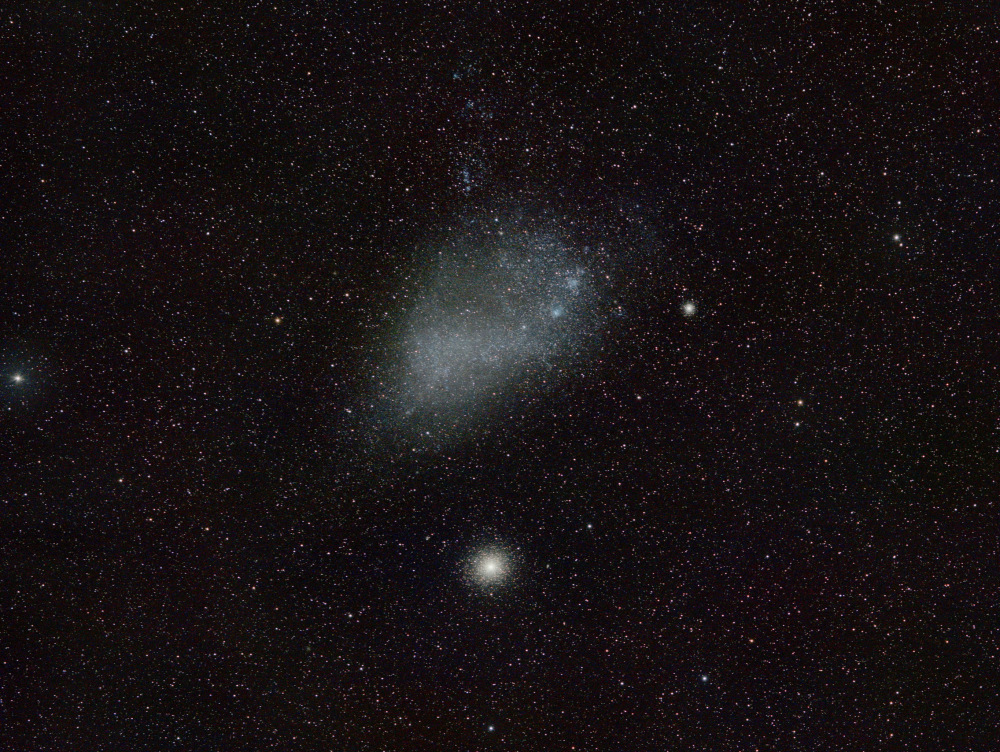
Earlier this year, I happened to meet Elineema from Tanzania. He spent some time in Austria for studies. More importantly, he is responsible for the Mount Meru Astronomical Observatory (https://mmao.space). During his stay he contacted the observatory to participate in one of the observation nights. After a perfect night at the observatory and a few more follow up meetings, he invited me to visit ‘his’ observatory. When the decision was finally made to travel to Tanzania in November, preparations startet. Apart from plenty of time for Tanzania and the incredible african wild life, a key component was to promote astronomy. The importance of astronomy in curriculum is not (yet) comparable to Austria. It also seems that some teachers are not sufficiently trained in astronomy. Therefore, the MMAO frequently organizes teacher trainings. This time, it was me to guide a group of teachers through a day of Oh’s and Ah’s of astronomy. Another part was to visit schools and a university and get into contact with many students, teachers, headmasters, … who were all so welcoming and fascinating personalities!
Personal note: Asante kwa kila mtu niliyekutana naye Tanzania. Hasa kwa Elineema na familia yako shukrani zangu za dhati kwa wakati huu wa ajabu na usiosahaulika!
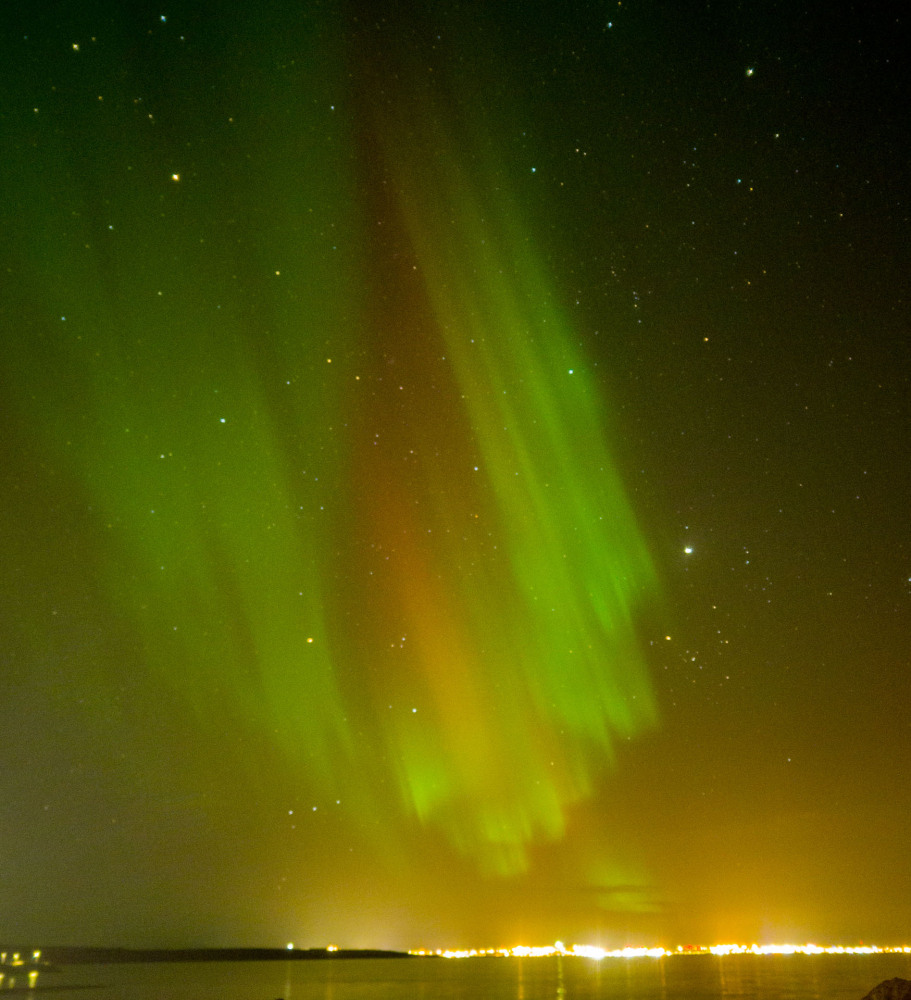
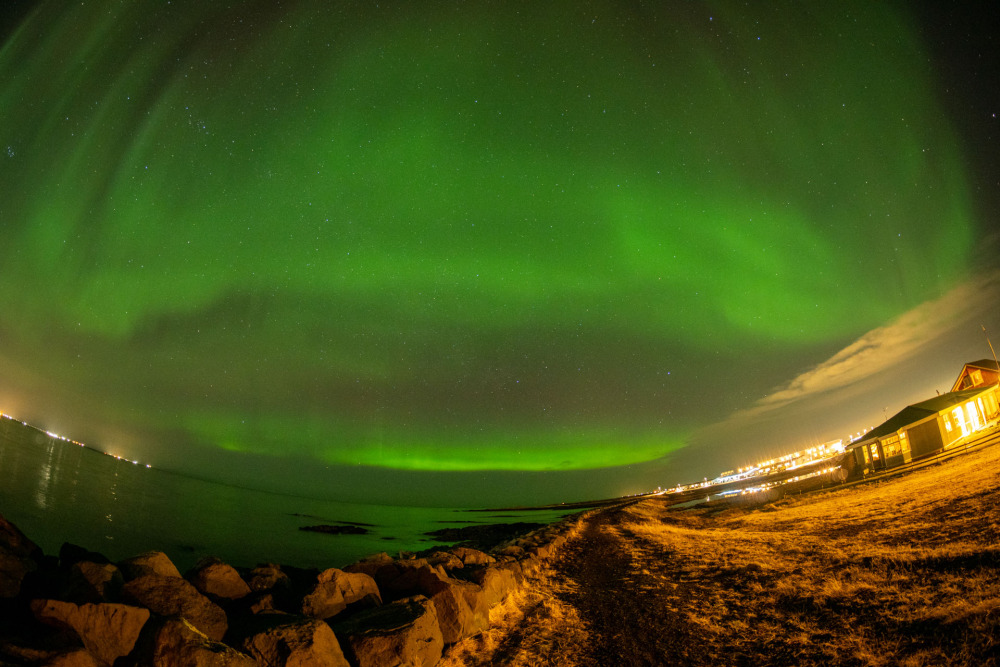
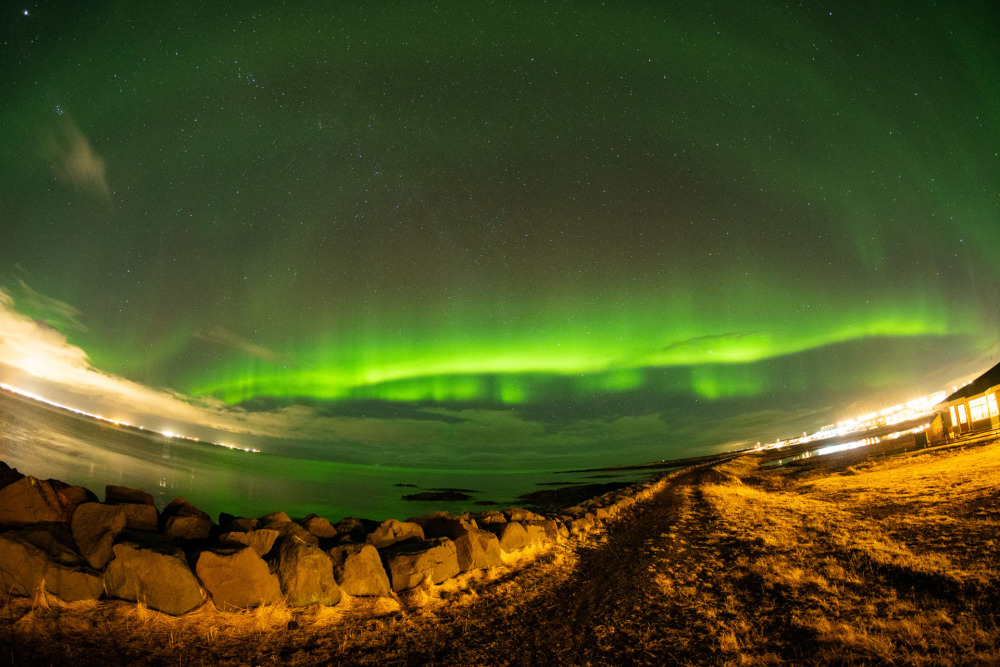
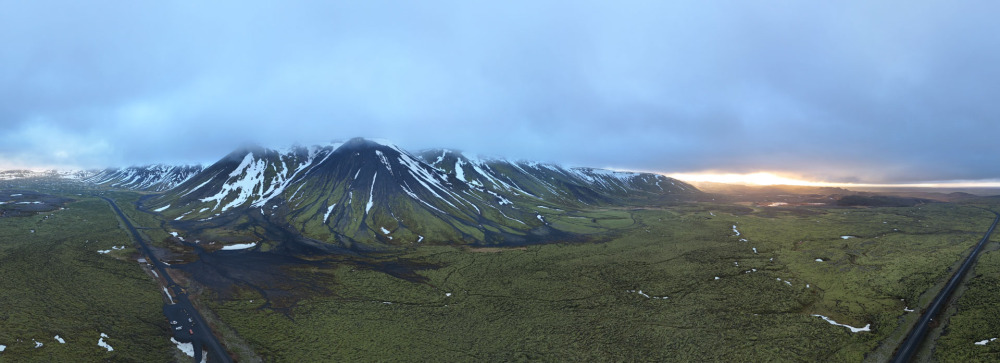
With the sun in solar maximum 2024 had several fascinating aurora events even far from the aurora oval at around 66 degrees latitude. Therefore I planned for a trip to Iceland, to see aurora in its best. Who could expect the sun to take a pause, so no significant eruption takes place from the first days of 2025 on? Reencouraged with a note from space weather officials, that the setting of interplanetary magnetic field, earths magnetic field and the ring current was favorable to produce aurora at least close to the aurora oval, I travelled to Iceland. Arriving there in anticipation for a pristine northern winter experience had another surprise at hand: a large low pressure zone lured south of Iceland. This low pressure zone caused strong winds (reaching almost 30m/s), lots of rain and unusually high temperatures (up to 9°C) for February.
After four days of grey skies and rain, weather was improving a bit. Even a 3-4 hour window of cloudless skies was predicted for the late evening. As if planned, when the clouds subseeded, the aurora began its show. Most of the time, Aurora was like eery greyish cloud bands to the naked eye. But during phases of increased intensity, green and red tones were also clearly visible. On camera, especially the green aurora looks spectacular!
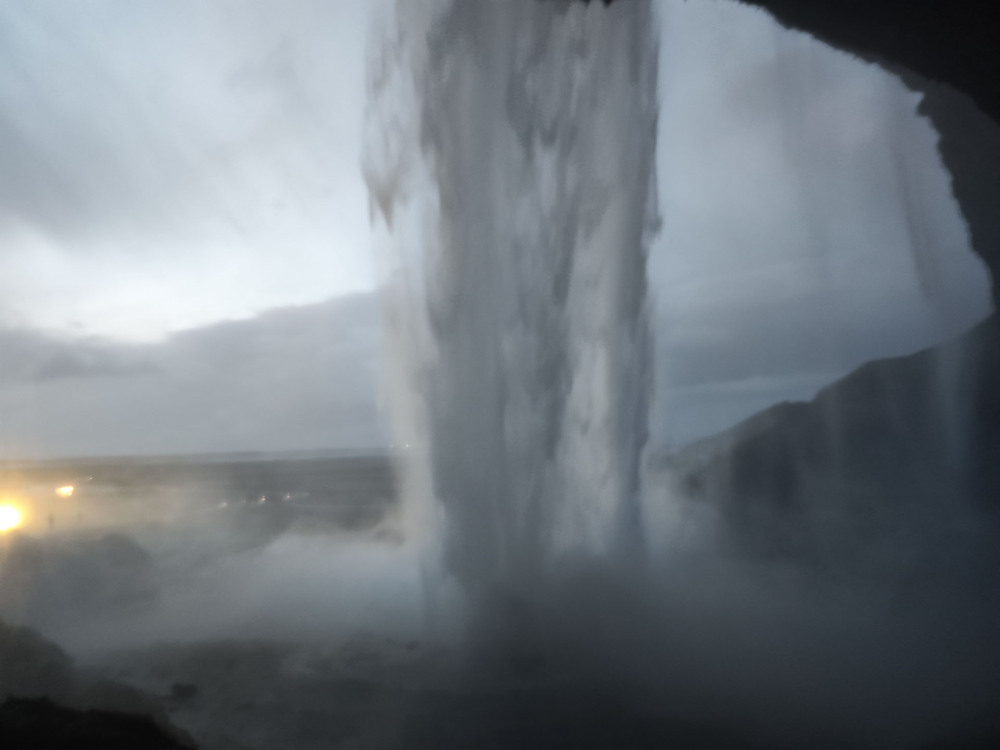
The following day was again quite wet. But at night, once again a few hours with little cloud cover provided another aurora show to be witnessed. To top off the Iceland experience, on the last day a few moments of sunlight during sunset let me part in joy to have seen aurora and the beauty of this island
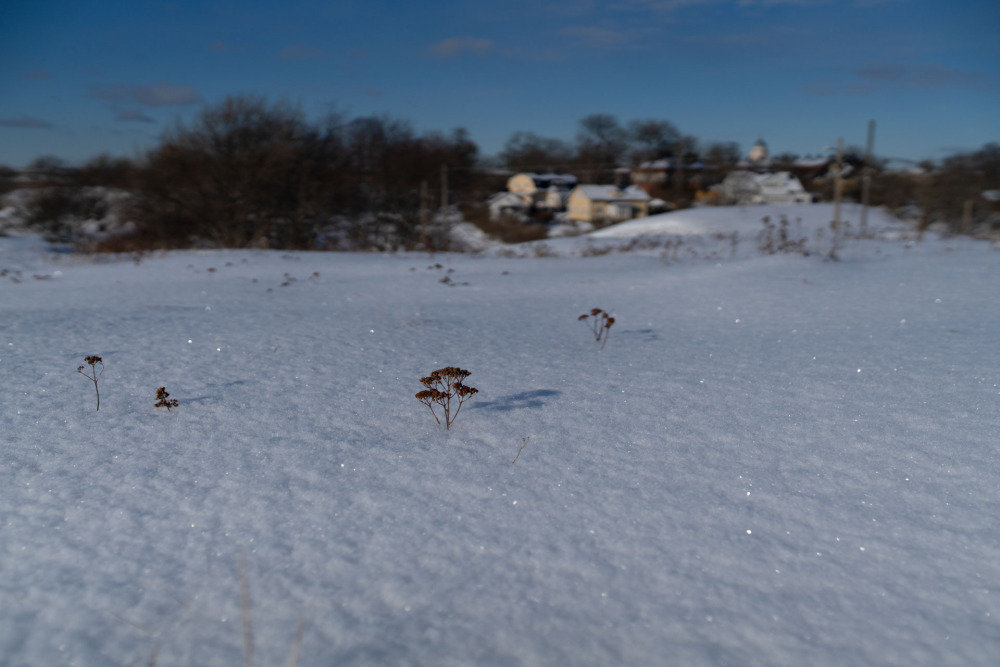
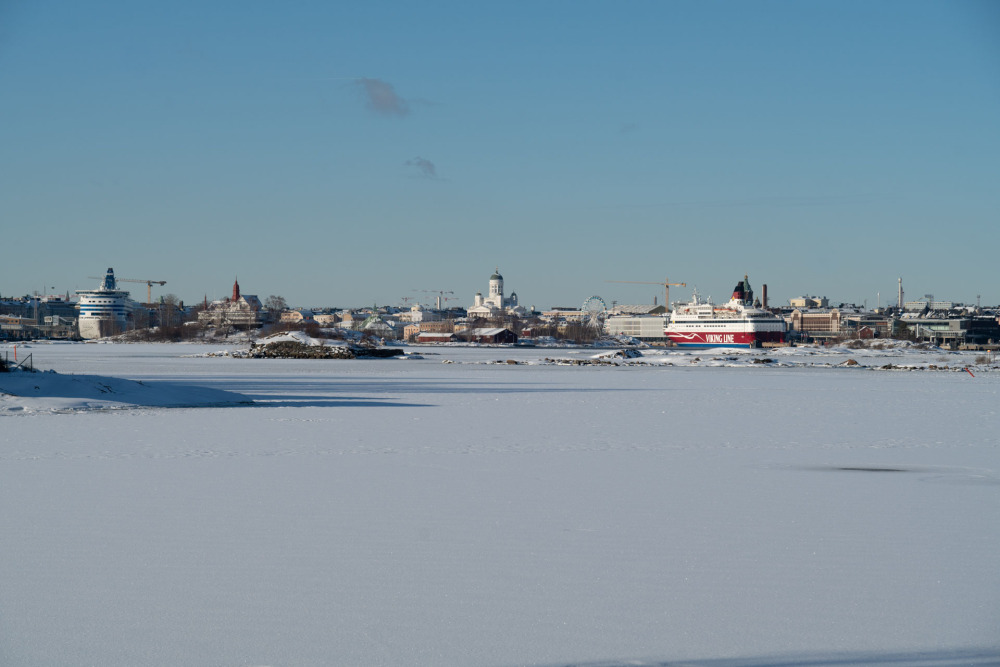
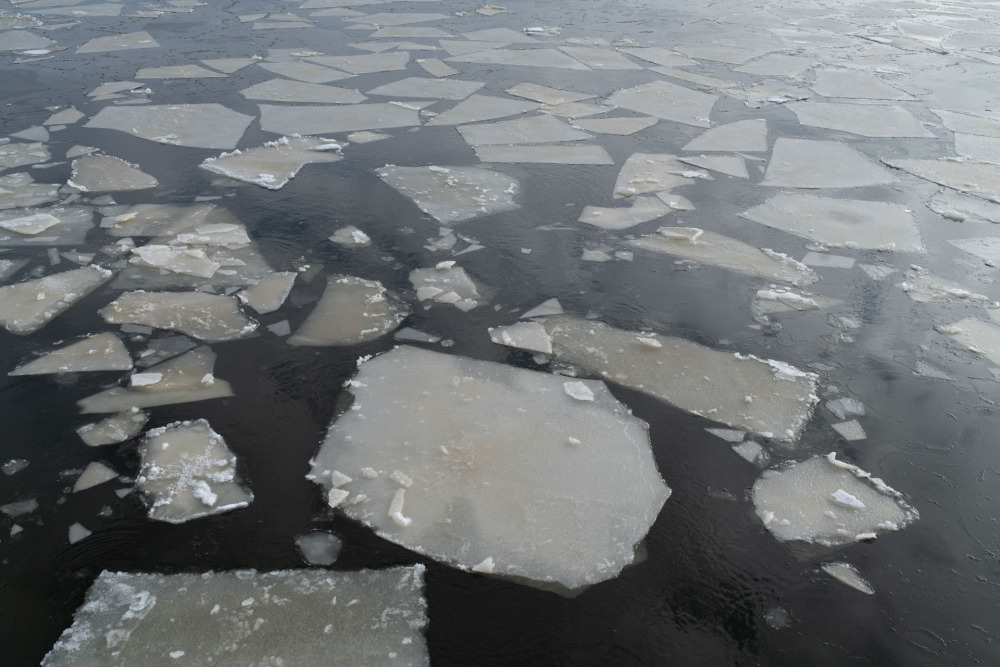
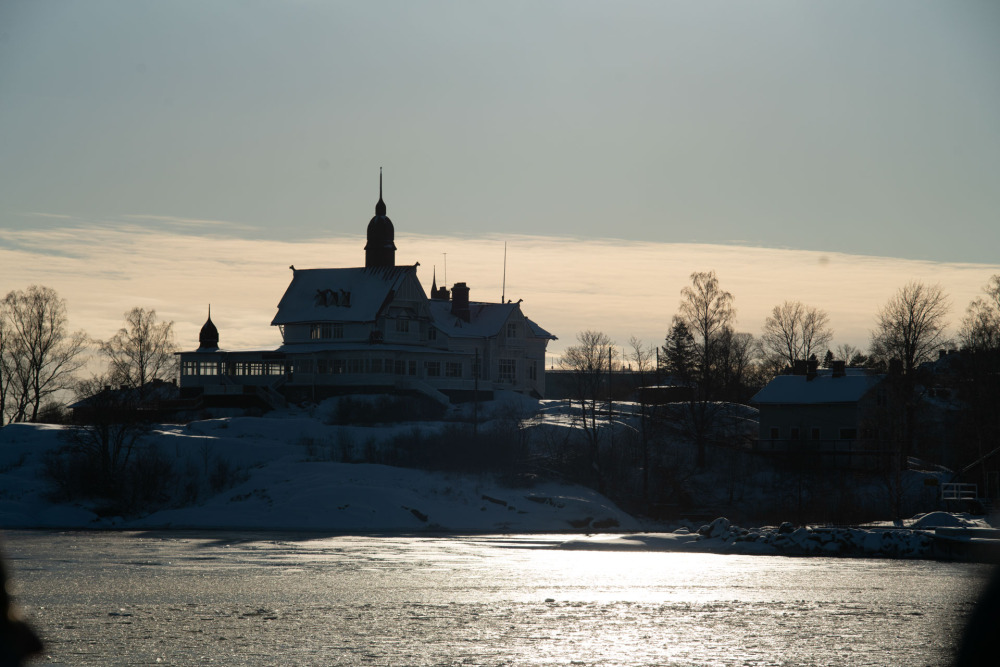
Recently I visited Helsinki (Finland). Temperatures dropped down to -15°C, causing even the waters in Kruununvuorenselkä to freeze over. Further out, patches of ice foes were drifting. Along with a fresh blanket of snow, everything just looked amazing. Especially Nuuksio national park close to Helsinki provided a marvellous setting for a great time
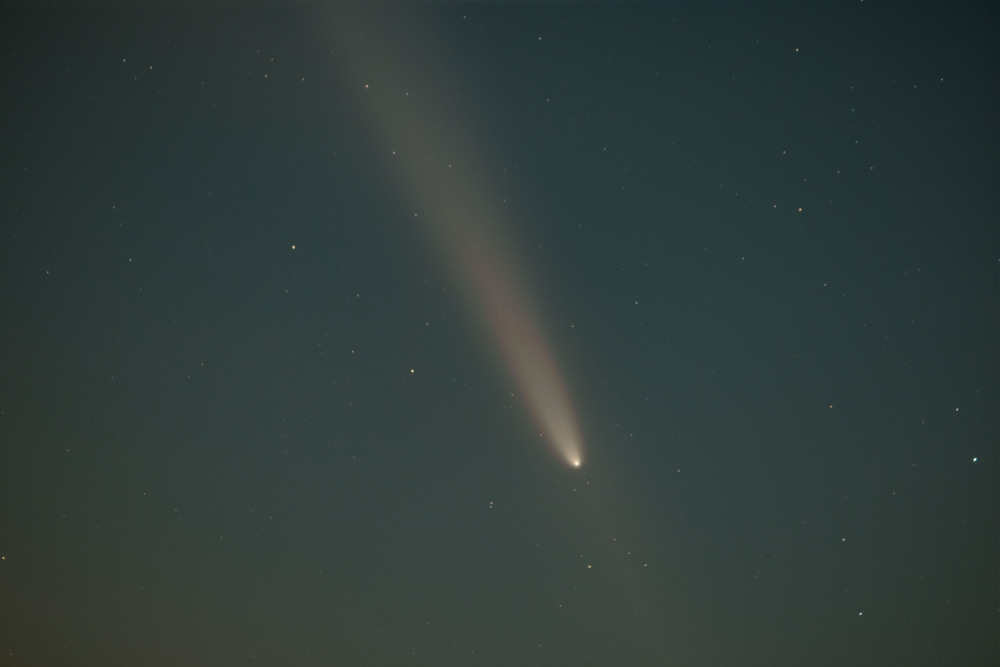
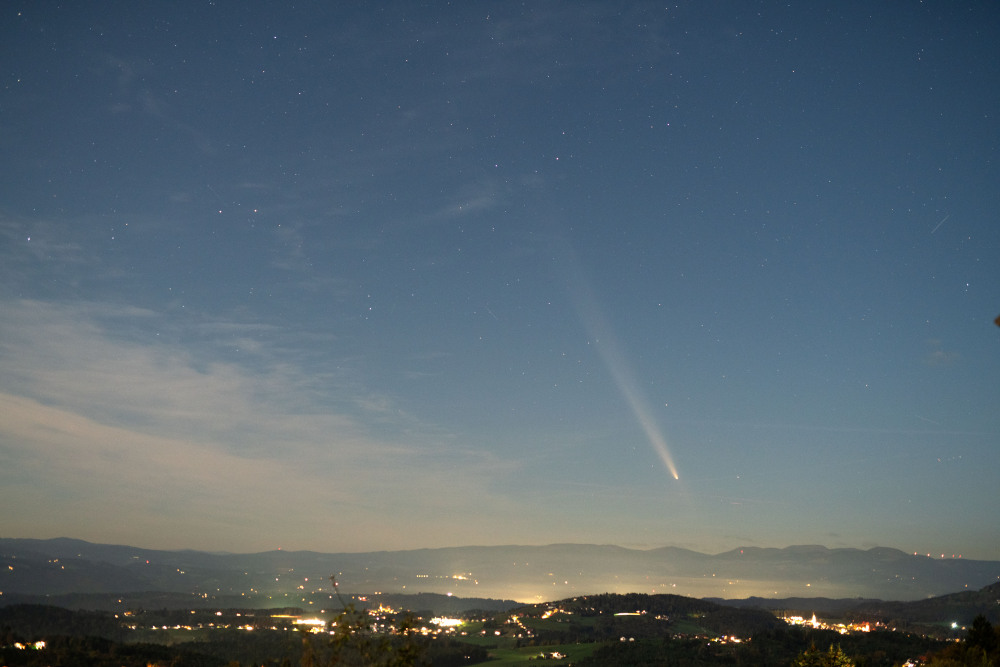
Finally, the long awaited comet C2023/A3 Tsuchinschan-ATLAS reappeared after its passage close to the sun. With a well timed window between clouds, I could observe and image the comet. From all the announcements, I expected the comet to be brighter. But still, it is a naked eye comet to enjoy with a pretty long tail.
The sun follows a regular cycle of activity and quietnes. This cycle takes 11 years to start over again. By chance, the 2017 total solar eclipse was at the solar minimum and the 2024 total solar eclipse was at the most active phase – the solar maximum. Comparing the images I took during totality of the two eclipses, the solar corona also reflects this.
During the solar minimum, the corona looks more structured. At the poles, the corona shows a well defined pattern resembling the magnetic field lines.
In contrary, during the solar maximum, there are more jets and streamers (also at the poles) but there are less structured patterns. Especially the inner corona looks rather chaotic compared to the quiet sun.
It will be fascinating to compare these images with further images from other eclipses…
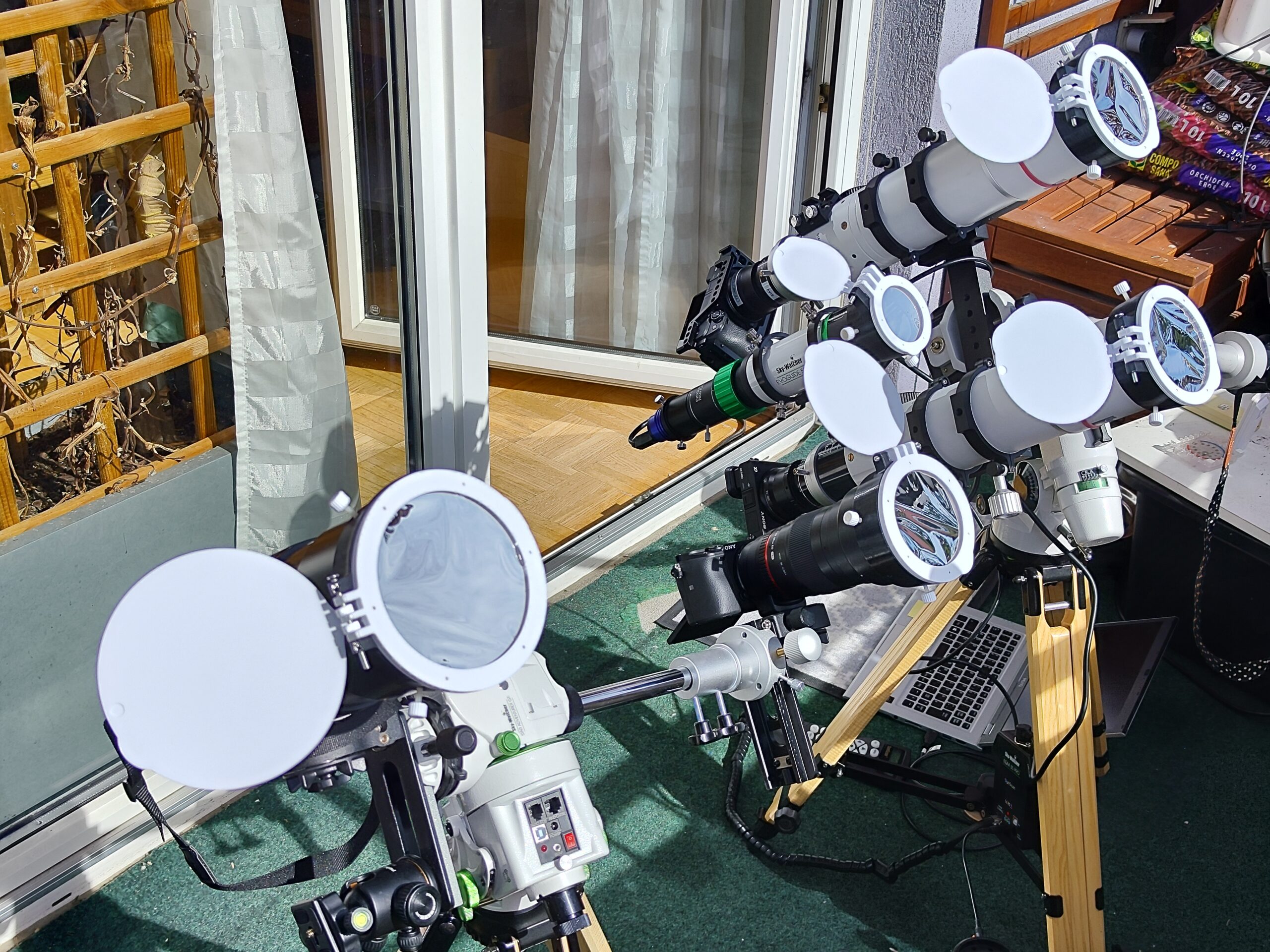
The main reason to travel to the US and go on a road trip to follow almost the entire golf coast from east to west was to see and photograph the total solar eclipse on April, 8th. My plan was to image with a total of 9 cameras. Most of the cameras got a custom made (see my 3D design here: https://www.thingiverse.com/thing:2431974) flip-away solar filter, to facilitate the on and off during totality. As I was up to share my photos with the scientific community through the Eclipse Mega Movie project, like in 2017 (https://eclipsemegamovie.org/), I had some constraints to follow for my setup.
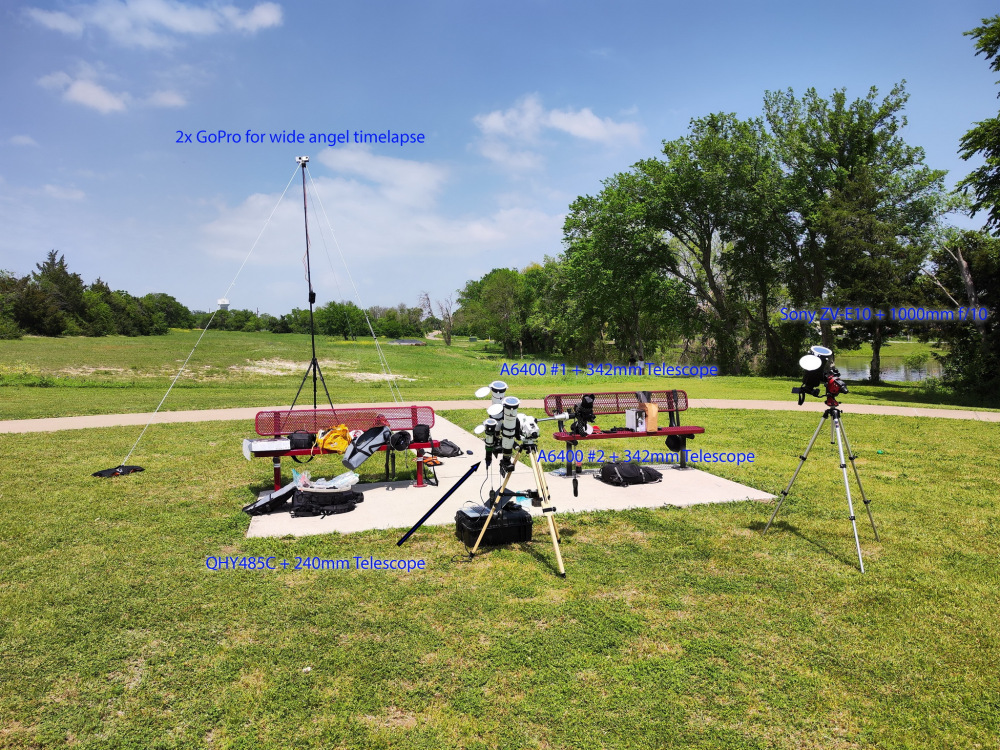
Therefore, the complete setup, which should be mounted on 4 independent tracking mounts, was:
Sony A6000 full-specturm modified with 80/600mm APO
Sony A6400 with 72/435mm APO for longer exposure sequences
Sony A6400 with 72/435mm APO for shorter exposure sequences
Sony A99ii with 35mm lens to capture the eclipsed sun with planets and hopefully a comet
Sony A58 with 135mm lens
Sony ZV-E10 with 100/1000mm maksutov
QHY485C with 50/242mm APO for a totality video
2 GoPro cameras for scenery
Test setup with almost all cameras
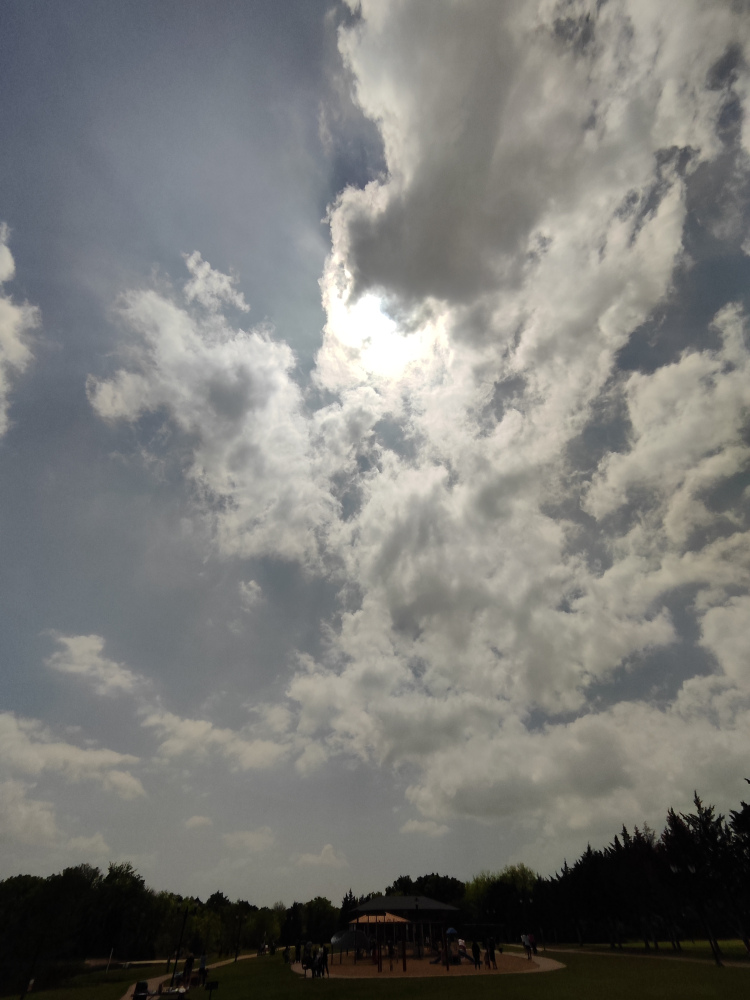
With bad luck, the airline was incapable of delivering one piece of luggage with my primary tracking mount within almost 3 weeks. Therefore I had to reduce the actual setup for the eclipse day in parts. Furthermore, it was quite unsure, whether observing the eclipse was even possible. A wide stretched cloud system covered large protions of Texas. In the morning, there was not even a patch of blue sky visible. Luckily, the clouds got less and less and even the one cloud covering the sun a few minutes before totality moved away. So we finlly could observe the eclipsed sun with an almost perfect sky. In the end I was able to record the required images, totaling to more than 400 GB of data.
This site uses cookies. By continuing to use the site (including navigation and scrolling), you agree to the use of cookies. more information
The cookie settings on this website are set to "allow cookies" to give you the best browsing experience possible. If you continue to use this website without changing your cookie settings or you click "Accept" below then you are consenting to this.